ʻO le Tala o le Vaʻatele o Lata
The Story of Lataʻs Voyaging Canoe
As we say, e tala lasi Sāmoa – Sāmoa is full of stories – and the story of Lata has various versions and variations throughout Sāmoa and the Pacific. This version is Unko Jake’s retelling (in English) of one of the many Lata stories.
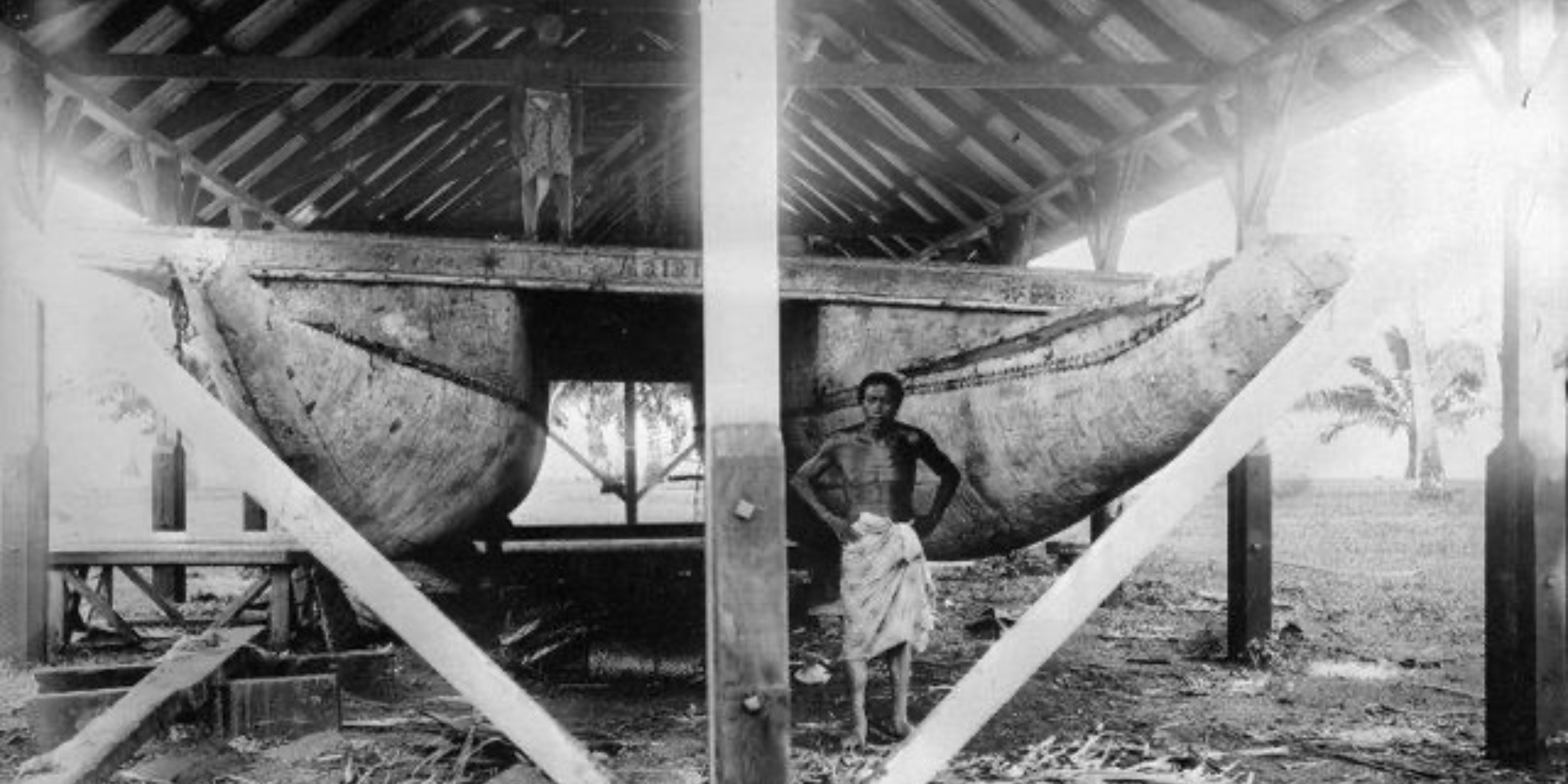
Photo: Photographer unidentified, 1910, “Unidentified man alongside a catamaran, at Mulinu’u, Western Samoa”, 1/2–045039-F, National Library of NZ. Visible writing on the fa’amuamua beam is “MAIAI.”
The outrigger vaʻa canoes that the ancestors had used to sail to Sāmoa were sturdy and sophisticated enough to make the voyages from island to island to Fiji (~550 miles from Vanuatu to Viti Levu), and then to Tonga (~300 miles from Lau to Tongatapu) and Sāmoa (~350 miles from Vava’u to ‘Upolu), but a more advanced, robust vessel was needed for the open ocean voyages required to sail to Rarotonga (800+ miles from Manu’a), Aotearoa (~1,700 miles from the Cook Islands), and Hawai’i (~2,100 miles from the Marquesas).
Lata – known elsewhere in Polynesia as Lasa, Rata, or Laka – was a famous adventurer and skilled sailor who is credited with building the first vaʻatele, or double-hulled voyaging canoe. But his invention wasn’t initially prompted by the dream of sailing across the horizon to discover new islands, it was inspired by his yearning to avenge his father’s murder.
While fishing near Tafagafaga, on the eastern side of Taʻū island (Manuʻa), two canoes approached Lata bringing news that his father, Fafieloa, had been slain by a rival chief named Matuʻutaʻotaʻo who lived near Fogātuli, on the southwest coast of Savaiʻi island.
The messengers who had brought the bad news had taken three days and three nights to sail the 200+ miles from Savaiʻi to Manuʻa, tacking against the wind on a winding course around ʻUpolu, past Tutuila, before finally arriving at Taʻū. Lata knew his father’s murderer was expecting retribution, and each passing day gave Matuʻutaʻotaʻo more time to flee and hide somewhere remote, or to recruit allies to protect him.
Lata couldnʻt wait three more days and nights; he couldnʻt let the man who killed his father get away.
In order to catch Matuʻutaʻotaʻo by surprise, he needed a vaʻa that could sail faster, with more stability, and carry more warriors than the kinds of canoes they already had. Thinking quickly, he ordered his fatherʻs servants to remove the ama outriggers from their canoes and tie the main hulls together.
This new configuration provided space for a broad deck platform, a taller mast, bigger sail, and even a fale to serve as shelter for the crew. Lata was impressed with the new canoe and impatiently shouted for the crew to set sail, indeed when the twin hulls of the vaʻa were pushed into the sea at Manuʻa, only half of the deckhouse had been completed.
According to the story, this is why the houses built on the vaʻatele and ʻalia canoes looked like they were only “half built.”
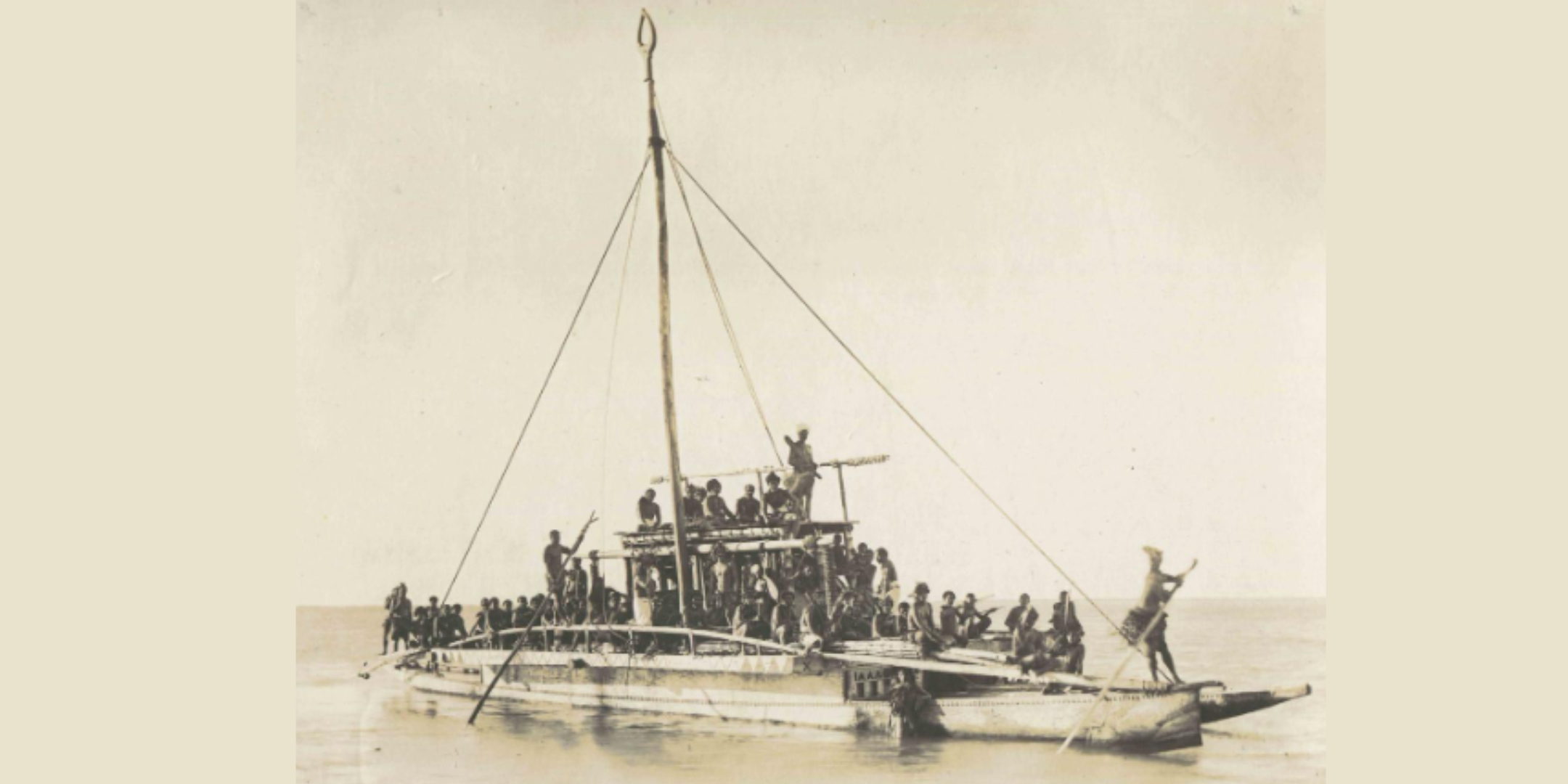
Photo: Alfred Tattersall, 1890-1900, the Fa’ataugali ‘alia at Mulinu’u prior to being housed in faleafolau; Hufnagel-Betham Family Collection, Museum of Samoa.
Lataʻs instincts were correct, and the double-hulled design provided speed and stability unlike any of the outriggers the people had experienced. Lataʻs voyage of vengeance sailed so swiftly that they reached the south shore of Savaiʻi within 24 hours, to the complete shock and surprise of all the people who saw Lataʻs new canoe flying over the waves.
However, in his overconfidence and blind rage, Lata had overlooked the actual skill of his crew, who were inexperienced at handling such a large, fast vessel, and as they rounded the coast past Taga, Lataʻs maiden voyage came to a crashing grand finale as the double hulls of the canoe smashed into a coral reef and instantly turned to stone.
This rock formation, called the Vaʻa o Lata (or Maʻa o Lata) is still visible today off the coast roughly halfway between the villages of Taga and Salaʻilua.
After avenging his father’s death, Lata decided to build a new and improved va’a based on the makeshift one that he had quickly put together in Manu’a (yes, the one that sailed so fast that it crashed). He hiked into the jungle and found two beautiful ifilele trees growing perfectly straight and tall.
He went straight to work, swinging his stone adze (to’i) with all his might, sending woodchips in all directions, and finally – after a full day of backbreaking work – the two enormous trees fell to the forest floor. Lata was exhausted. He left his adze on top of one of the logs, made a comfortable bed on a big pile of wood chips, and fell into a deep sleep.
In the morning, Lata awoke to the singing of the morning birds, refreshed and ready to continue working on his great canoe. But when he looked around, he couldn’t believe what he saw: the two massive logs that he had spent all day chopping down were back in their original places, standing tall and strong as living trees!
There was no trace of wood chips or shavings, and his stone adze was nowhere to be found.
Confused, but still determined, Lata found a new stone blade, lashed it to a new wooden handle (‘au), and went back to work. Once again, he spent an entire day cutting down the trees, sending woodchips in all directions, and finally, after a full day of backbreaking work, he lay down to sleep.
In the morning, Lata awoke to the singing of the morning birds, refreshed and ready to continue working on his great canoe. But when he looked around, he couldn’t believe what he saw: the two massive logs that he had spent all day chopping down were back in their original places, standing tall and strong as living trees! There wasn’t any trace of any wood chips or shavings, and his stone adze was nowhere to be found.
Frustrated, but still undaunted, Lata found a new stone blade, lashed it to a new wooden handle (‘au), and went back to work. Once again, he spent an entire day cutting down the trees, sending wood chips in all directions, and finally, after a full day of backbreaking work, he lay down to sleep.
In the morning, Lata awoke to the singing of the morning birds, but when he saw that the trees had returned to their original places in the forest, he was not refreshed, nor was he ready to continue working on his great canoe. Furious, but still undeterred, he lashed a new adze and cut down the trees, but this time he lay down on his pile of wood chips and only pretended to sleep.
Just after midnight, Lata awoke to the chanting of eerie voices, and when he looked around, he couldn’t believe what he saw: aitu o le vao, spirits of the forest, emerging from the soil in the shape of worms, insects, grubs, caterpillars, and centipedes.
The aitu swarmed over the piles of wood chips and covered the fallen logs like a living, crawling skin, and Lata watched in amazement as the tiny aitu raised the huge tree trunks into vertical position and replanted them into the ground.
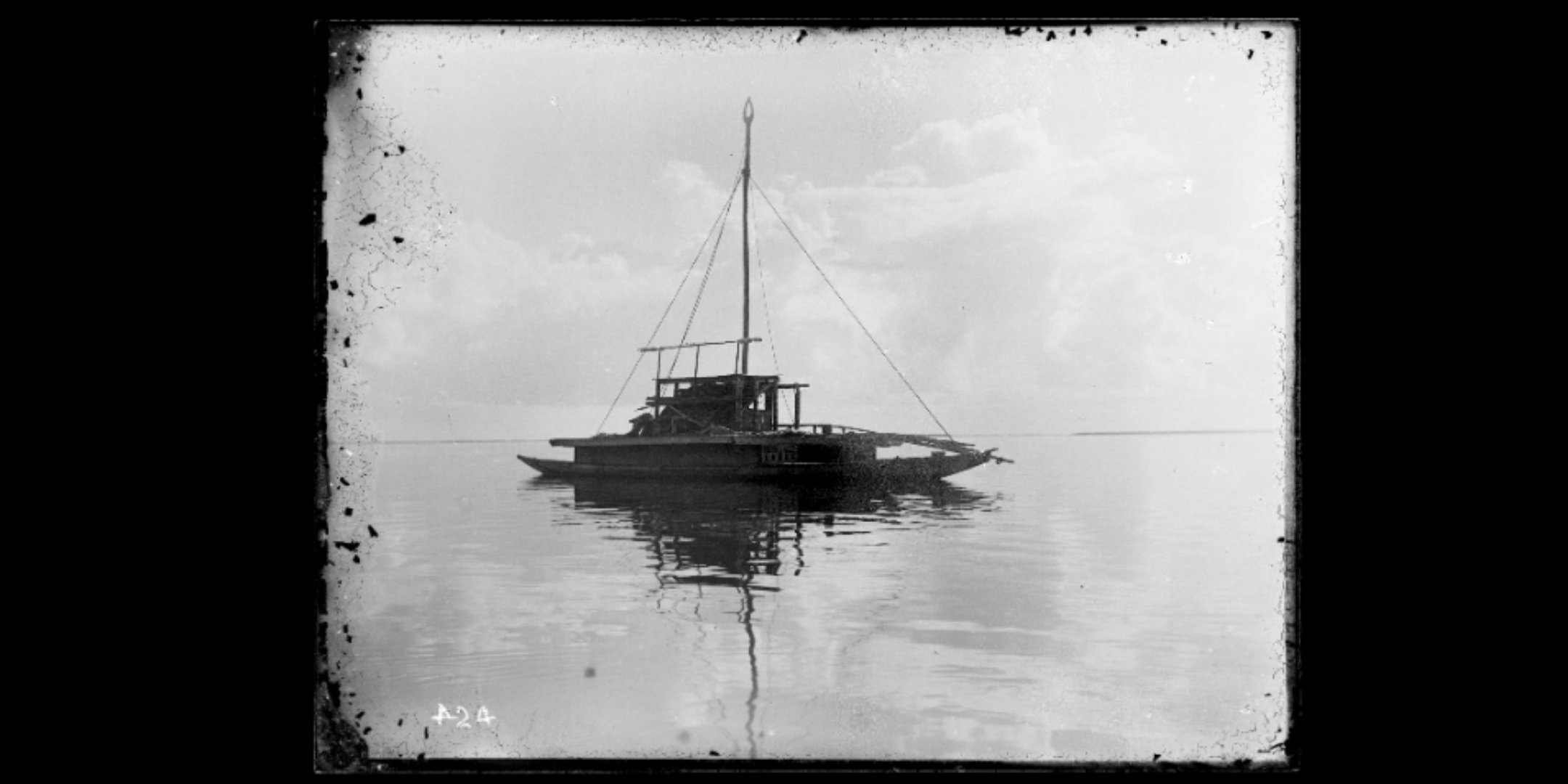
Photo: Thomas Andrew, 1890-1910, “alia double hulled sailing canoe” (Te Papa, O.002229). Possibly the Fa’ataugali.
In the morning, Lata was already wide awake before the morning birds started singing, and when he saw the trees had returned to their original places in the forest, he knew exactly why. Hopeful, but still a little upset, he walked to the village of Taga to consult with the wise elders about what to do.
The elders scolded him for failing to uphold the most basic value of Samoan society: fa’aaloalo – respect.
“How would you feel,” they asked, “if someone walked into your house unannounced and just started punching your children?” They explained that the forest is home to the trees, and that when people enter it, they are guests who need to treat it with respect.
“Well,” asked Lata, “I’ve never talked to a tree before. What should I say?“
The elders didn’t give him a straight answer, but instead told him a riddle: ā fa’atū ‘au, fa’aifo lā’au – “when the ax stands up, the trees bow down.”
Puzzled, but encouraged, Lata walked to the village of Sala’ilua to beg for a fine mat and some food (remember he had crash landed on Savai’i and didn’t have anything except his lavalava and his adze) and hiked back to the forest. He found the two beautiful ifilele trees he had already cut down three times, and he placed the offering of food on the ground near their strong roots.
As he covered the offering with the fine mat, he spoke to the aitu o le vao, addressing them with the same upu fa’aaloalo used when speaking to high chiefs.
But there was no response.
He humbly acknowledged his position as a guest and thanked the forest for its hospitality during the nights he had slept among the wood chips. But there was no response.
He politely asked, and then tearfully begged for permission to carve the trees for his great canoe. But there was no response.
In total frustration, he stood up to leave, tossed his adze at the base of the tree, and admitted his defeat. Disappointed after a long, hot, mentally exhausting day, Lata lay down to sleep.
Just after midnight, Lata awoke to the chanting of eerie voices, and when he looked around, he couldn’t believe what he saw: aitu o le vao, spirits of the forest, emerging from the soil in the shape of worms, insects, grubs, caterpillars, and centipedes.
The aitu swarmed over the majestic tree trunks like a living, crawling skin, and Lata watched in amazement as the tiny aitu removed the huge tree trunks (lā’au) from their roots and set them down (fa’aifo) onto the forest floor.
As the aitu slowly crawled back into the soil, Lata saw that the logs had been carved into the most beautiful canoe hulls he had ever seen. He threw himself to the ground and cried with gratitude, thanking the forest for the most incredible gift. When he looked up, Lata noticed his adze was resting against one of the logs, and he suddenly understood what the elders were trying to say through their riddle!
When he had dropped his adze at the base of the tree in desperation, it had landed with the heavy stone blade facing down and the handle (‘au) pointing straight up (fa’atū).
While he didn’t do it on purpose, he showed the forest spirits that the trees were more powerful than he was, and by setting down his adze – the only tool that made him stronger than the forest – he had acknowledged his place as a guest, not a chief, among the trees.
For his respectful gesture, the aitu o le vao gifted him with a magical canoe, the first va’atele voyaging canoe, that Lata and his adventurous crew of demigods would sail all over the Pacific Ocean.
To celebrate the completion of the canoe, Lata invited the entire villages of Sala’ilua and Taga to a lavish feast (umusaga) to thank them for their contribution to the building of the va’atele.
Because of Lata’s story, we still have the word fa’atū’au, which refers to a gift or a prayer offered before cutting down a tree to build a canoe. Umusaga still refers to festive gatherings that are held to celebrate the completion of a new building, a canoe, or a life milestone.
The many epic stories of Lata and his intrepid adventures are still preserved in local traditions and place names across Sāmoa, including Mauga Lata on Ta’ū, Manu’a (where Lata’s first canoe was built); Vao o Lata, Lata i Tai, Ala o Lata in Palauli district, Savai’i (where chapters of Lata’s story happened between Sala’ilua and Taga); Va’a o Lata in Fagaloa, ‘Upolu (where Lata’s canoe inspired the building of Tagaloa Funefe’ai’s va’atele named Pualele), etc.
The 2026 Utah Wayfinding Week is schedule for September 14, 2026- September 19, 2026 where we close out our week’s activities with Umusaga: A Voyage Made Ready. Join us on Saturday, September 19th, for a special evening of wayfinding talanoa and special community performances.